Reclaiming Collective Life: Toward Non-Transactional Relations
Capitalism has taught us to calculate one another.
We are all guilty of it. We engage in conversations, cultivate relationships, and even guide interactions toward enduring friendships while carrying a quiet, often unspoken thought deep within us. Few of us would be able to immediately name it, yet its influence on our sociability is profound. This ever-present concern about how, or whether, an interaction might produce material or strategic benefit for us is the condition I am alluding to. It is a social pathology produced in modern-day by capitalism, one that corrodes collective life and generates deep mental and emotional dysfunction.
What makes this contradiction heavy is that it also exists alongside working-class communities where an organic social fluidity, sense of mutual care and interconnectedness, still exists, and to the envy of much of the world, where the accumulation of capital and the culture of consumerism has become interchangeable with the purpose of life itself. In these spaces, collective survival has not yet been fully replaced by individual accumulation, and yet, capitalism has injected crisis into the hearts and minds of all, regardless of our geographical location. It has programmed us to see one another as competitors in survival, interpersonal life becoming a place where we attempt to settle a historic score, rather than experiencing relational life as the balm or reprieve that I imagine it was designed to be.
Is Seeking Benefit from One Another Unethical?
To advance this discussion, two questions must be addressed — one is whether it is inherently unethical to seek benefit through our relational lives, and the second is to define what is meant by benefit, for the sake of this analysis. On the question of ethics and whether it is morally correct or incorrect to seek benefit in relational life, there is no ethical deficiency in seeking, through people, the fulfillment of one's personal needs. In fact, the self-sufficient, self-reliant archetype of the human being is a dangerous illusion created by capitalism itself to turn people away from finding mercy within each other, and to seek it in consumerism (the act or ability to consume), which can provide nothing except the deepening of existential dissatisfaction. In fact, to create this image or archetype of the “needless” human being, capitalism has shamed the utilization of our direct communities as places to seek support. If we were to consider that we (human beings) were created for each other, to ease for each other the burdens of day-to-day life — be it grief, loneliness, economic hardship, illness, or otherwise — we can conclude that it is not only completely natural to seek from one another, but it is, I would argue, within our rights to do so.
Before examining how capitalism has distorted this right into a source of alienation, we must define what we mean by benefit. The definition could be broad, but for the sake of illustrating the point of this analysis — that capitalism is destroying the beauty and benefit of collective life — we will look at benefit as power in the form of social capital or access to some other form of social or political mobility; monetary gain, or the gain of some other resource representative of the power and value of capital (e.g., land or other assets).
What Capitalism Means by “Benefit”
Capitalism achieves this distortion through the privatization of essential resources for survival: land, water, healthcare, education, food, and housing. It has created a social climate in which, even where day-to-day solidarity is a must if survival is to be guaranteed, the ever-present feeling is one where naturally free and abundant resources are seen as perpetually scarce and thus only attainable for a few people. Capitalism nurtures this way of thinking, emphasising the precarity of our survival by affirming — through its media empires and storytelling via the digital world — that if we are not amongst the few that so-called “fight” and “win” access to these resources through capitalism's long-held rallying cry of ‘hard work’ (a myth, for capital doesn't guarantee any social or economic security based on how hard a person works), then we risk being discarded. Still, capitalism insists that failure to survive is a personal defect, the result of being outsmarted or outcompeted by those we were never supposed to face in battle (our own communities) and who we now perceive as having access to what only capitalism has defined as being possible to privately own or access. It is under these conditions that the mutually dependent society and its social traits begin to die, and what we defined earlier as a natural way for human beings to seek benefit from one another takes on a perverse nature, where interdependence expressed without shame — as all resources are abundant and collectively owned — is seen as inherently weak or shameful behaviour, so one must avoid the transparent expression of need and instead perform an outward condition that masks vulnerability, all whilst seeking to extract from one another what we are calling “benefit” in this analysis. In the world of capitalism, where some must suffer for others to prosper, this perversion and the way it has ingrained itself into our ways of being (which we can absolutely become free of) can see us not only seek out relationships where we feel our time, energy and presence will get the highest return on investment (again, subconsciously) but it can also produce dynamics where people keep from each other what might be of benefit to others, as capitalism teaches us not all will survive, not all can have access to basic and necessary resources, so the less others have, the higher our chance to attain.
Refugees, Scarcity, and the Politics of Perception
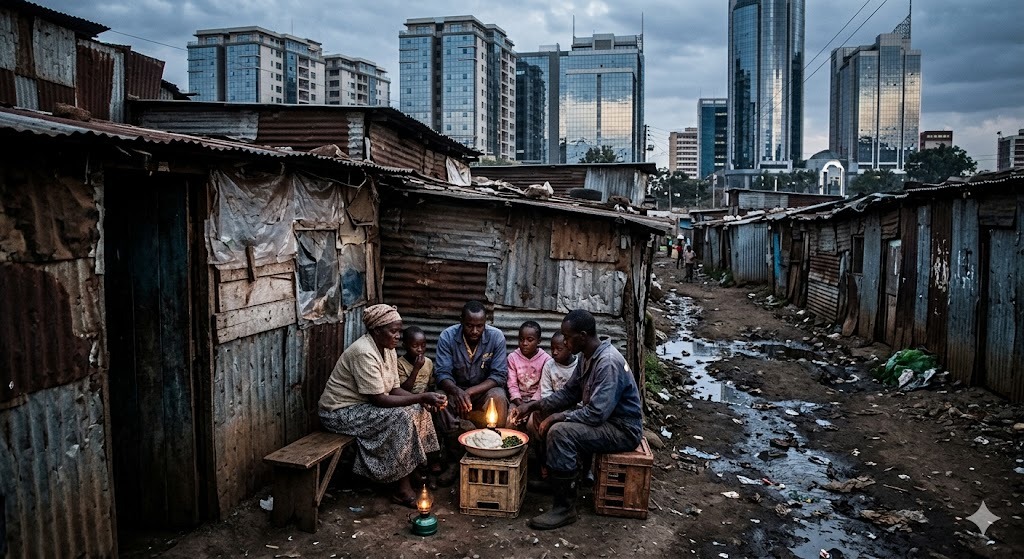
An example of this condition that I have observed over the years is the relational dynamic between refugee communities from the Horn of Africa residing in Nairobi and the local Kenyan community. Of course, it is an overall positive dynamic where communities are not intentionally out to harm each other and, for the most part, coexist. Though there are other perceptions that these communities have of each other that are destructive and a product of the way capitalism has informed our relational lives. Many Kenyans perceive refugee communities to be well off, understanding that many refugees from either Ethiopia or Eritrea are supported by family members living in the West as they undergo resettlement processes. Whilst true that many refugees have support abroad, most households can only survive off of these funds because they have built grassroots solidarity economies, where local businesses accept payment for goods once or twice a month but still provide people with everyday needs. Still, the perception is that this community has access to what the local Kenyan community does not, and as a result, we see punitive practices take place in communities like police doing rounds in areas where refugees have businesses and collecting what can be likened to informal taxes. In the reverse, refugee communities (my experience has been specifically with the Ethiopian community in this regard) see local communities as living in a country that is perceived as having more freedoms and experiencing more development than their home country, and thus create dangerous tropes about Kenyan people to understand the conditions of poverty and injustice in the country. These perceptions cause a frightening level of indifference when the people of Kenya face state violence. Even though it is the same state mechanisms causing misery in the lives of refugees on a day-to-day basis, the cloud capitalism creates over the heart disables refugee communities in their ability to empathize and be in solidarity, and likewise, local Kenyan communities also display a great level of apathy towards the structural violences that refugee communities face, even though it is the same state mechanisms that brutalise them. Rather than enjoin in a healthy collective life whereby having needs is seen as unashamedly human, resources are organized to be shared, seeing capitalism as the main aggressor and the inability to survive under capitalism as nothing to be ashamed of, people see resources as inherently scarce and each other as either a competitor or someone that one may be able to benefit through. Under such conditions, we have a transactional society, not communal life.
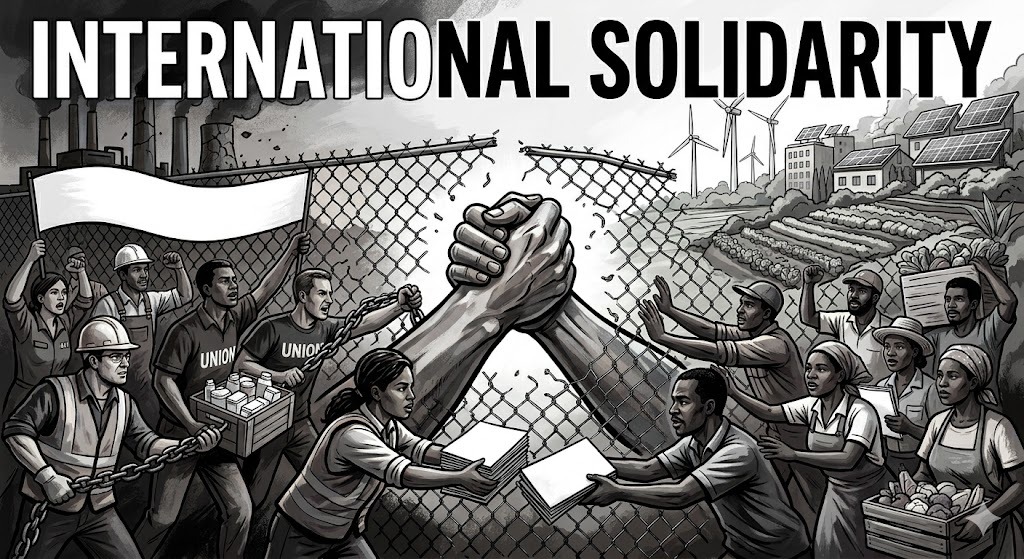
One could argue, then, that if everyone were able to somehow meet all of their needs under capitalism, collective life would repair itself. What then explains the culture of extreme transactional relationships and communities that much of the global north is privy to? We can recall a social media trend that went viral last year, sharing how families in Scandinavian countries respond to having to feed the children of other people, many opting to have dinner as a family, whilst the children of other families simply did not eat. I think it is safe to say that even amongst the conditions discussed earlier in this piece, one would be hard pressed to find a situation where this kind of dynamic would play out in the global south, meaning that more resources do not necessarily equate to less transactionalism in relational life. So, what is our solution? Of course, it is to destroy capitalism. Though not just its political and economic structures, but we must also fight to destroy the strongholds that it has established within our hearts and minds, for without this deeper reckoning, the system's fall will only reproduce its values in new forms, denying us the possibility of a truly new world.


0 Comments