The Collapse of Capitalism and I am not a Cat
A Reflection, in both ordinary and intellectual terms, refers to a return, a turning back that allows deeper understanding of the forces at play. This essay is a reflection on capitalism itself—its motion, contradictions, and unfolding crisis, particularly as experienced in Africa and other oppressed regions of the world. The unfolding crisis is a structural necessity to aid the forces at play to exercise their greed while controlling and manipulating the masses and other forces of nature. These actions have set in motion the inevitable collapse of capitalism, and through this reflection it confirms I am not a Cat.
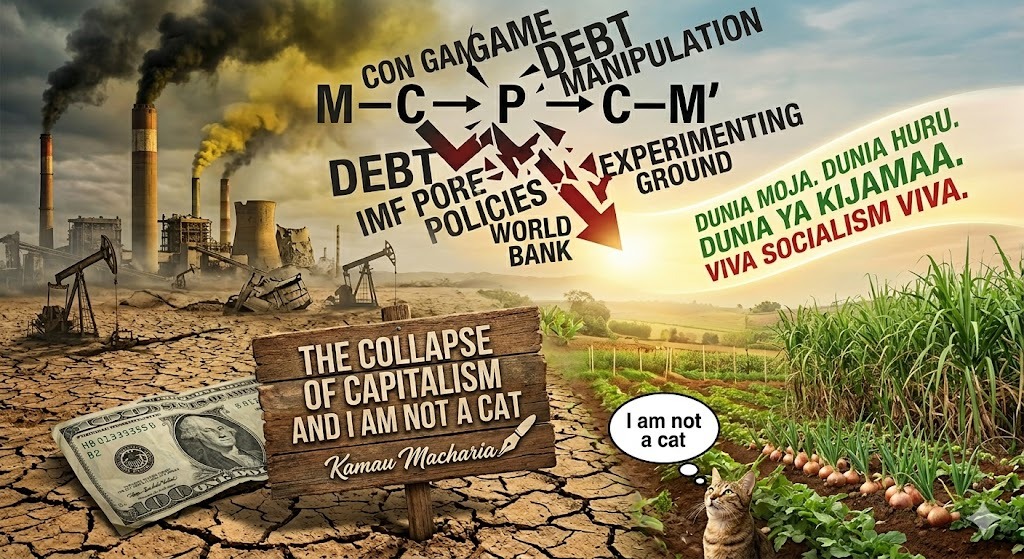
In Capital, Volume II, Karl Marx describes the circuit of money capital as the process through which money transforms into commodities and back into money but in an expanded form. This cycle forms the foundation of capitalist production and accumulation.
- Stage 1 – Money to Commodities (M–C)
- Stage 2 – Production (P)
- Stage 3 – Commodities to Money (C–M′)
From the first stage we see that the monetary authorities — manufacturers of money as commodity — set the entire con game in motion by producing the first commodity needed for capitalism to transact, and that is money (physical and digital). The capitalist producer turns money into raw materials and labour into profitable commodities, and the cycle continues endlessly, feeding the engine of capitalism.
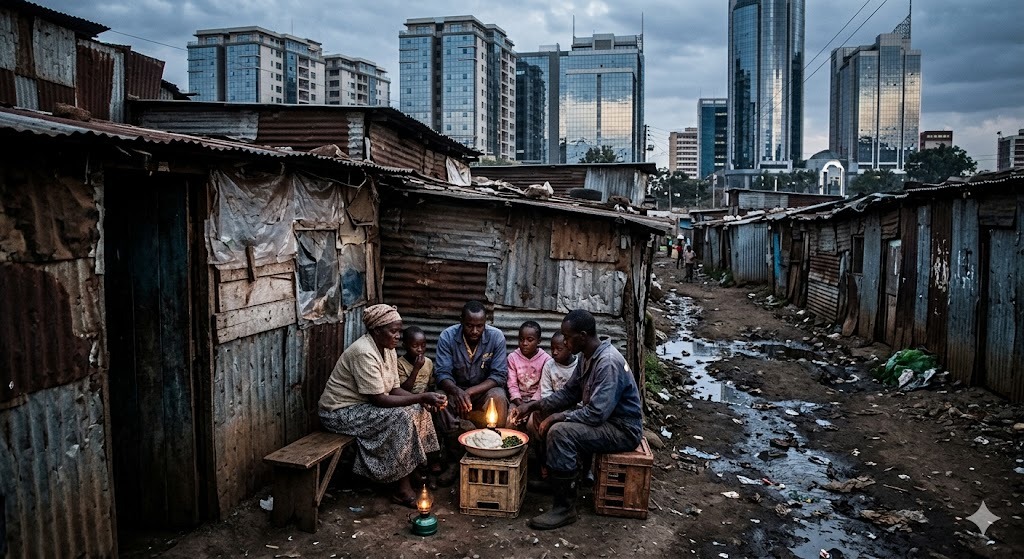
In the second stage, the capitalist carries the greatest burden: the weight and work required to sustain capitalism. When this weight becomes too heavy, the manufacturer of money offers a solution: the sale of debt, distributed through banks and financial intermediaries — the modern wholesalers of the commodity called money. This is harshly experienced in Africa, as it is used as an experimenting ground for financial crises needed to stimulate the capitalist systems. This is seen by different IMF and World Bank policies shoved down the throats of Africans. When the producers in the second stage can no longer access credit from these institutions, they are driven to retail money markets — loan sharks and shylocks — where interest rates are crippling. In this way, the manufacturer of money distances themselves from the hardship of production, leaving the working producers and small capitalists to struggle. Only a few privileged actors receive bailouts when the system trembles. The rest are left to collapse under debt and competition. Thus, greed, favouritism, and impunity become the catalysts of capitalism's eventual downfall.
The third stage marks the fall-off of the capitalist con game. The manufacturer of money from stage one returns to the market as a seller. The capitalist of stage two, who once produced and laboured, now becomes the buyer — trapped in the same system he helped sustain. Money, therefore, is produced as the means through which wealth, accumulated from production and the value added by labour, is transformed and preserved. This transformation is inevitable because capitalists must keep their wealth in motion: to move, liquidate, or save it through monetary form. This reveals a profound truth: no one, except the producer of money itself — the Federal Reserve, the IMF, and the World Bank — is financially secure. Producers and peasants alike remain at the mercy of those who control the creation and circulation of money.
Even the most disciplined and "honest" capitalist cannot escape the distortions, crises, and uncertainties embedded in this system.
As Kate Raworth argues in Doughnut Economics, mainstream economics remains fixated on perpetual growth, ignoring the ecological and social boundaries of our finite world. Her intervention resonates strongly with African realities, where growth has often meant extraction without social justice or ecological repair.
Marx's circuit of money capital exposes the self-reinforcing loop of capitalist production: money creates commodities, commodities create more money, and the cycle repeats until the limits of the real world intervene. But this cannot grow forever on a finite planet. If such endless growth were possible, it would defy nature itself, at which point I might as well claim that I am a cat. This leads to one realisation:
Dunia Moja. Dunia Huru. Dunia ya KIJAMAA. Viva Socialism. Viva.
0 Comments